
How to Check Criminal History in Kittanning
Begin by deciding whether the goal is a police report, a court docket, current jail custody, or a Pennsylvania criminal-history certificate. Kittanning does not advertise one city database that combines those sources. The same name can appear differently across them because each office records a different step.
- Contact Kittanning Borough Police for a report created by its officers and ask for the Open Records Officer or report procedure.
- Search the Unified Judicial System portal for proceedings at MDJ 33-3-02, using a participant name, docket number, OTN, SID, or complaint number when available.
- Check the Court of Common Pleas when a misdemeanor or felony was held for court, and request non-online filings from the Clerk of Courts.
- Call Armstrong County Jail for present county custody because no official public county roster was located.
- Use PATCH for a standard statewide name check, or PSP Access and Review when auditing your own complete Pennsylvania record.
These steps should not be collapsed into one result. UJS warns that a court search is not a background check, while a public PATCH certificate is not the subject's complete rap sheet.
Kittanning Records Around Market Street
Kittanning’s role as county seat makes record offices feel geographically close while their legal duties stay distinct. Borough police work from South McKean Street. The county courthouse complex uses both 450 and 500 East Market Street addresses, and the jail is outside downtown on Staley’s Court Road. That layout matters when a Kittanning search moves from a police event to a court file or booking confirmation.
The Clerk of Courts counter is at 500 East Market Street, Suite 103. It keeps Common Pleas criminal dockets and filings, including motions, bail records, appeals, fines, costs, restitution, and qualifying sentencing material. The Sheriff is in Suite 106 and serves warrants, transports prisoners, and manages courthouse security, but that office is not the custodian of every Kittanning police report.
The official Armstrong County contact directory shows how these offices are divided. The captured county contact view below is a useful orientation aid.
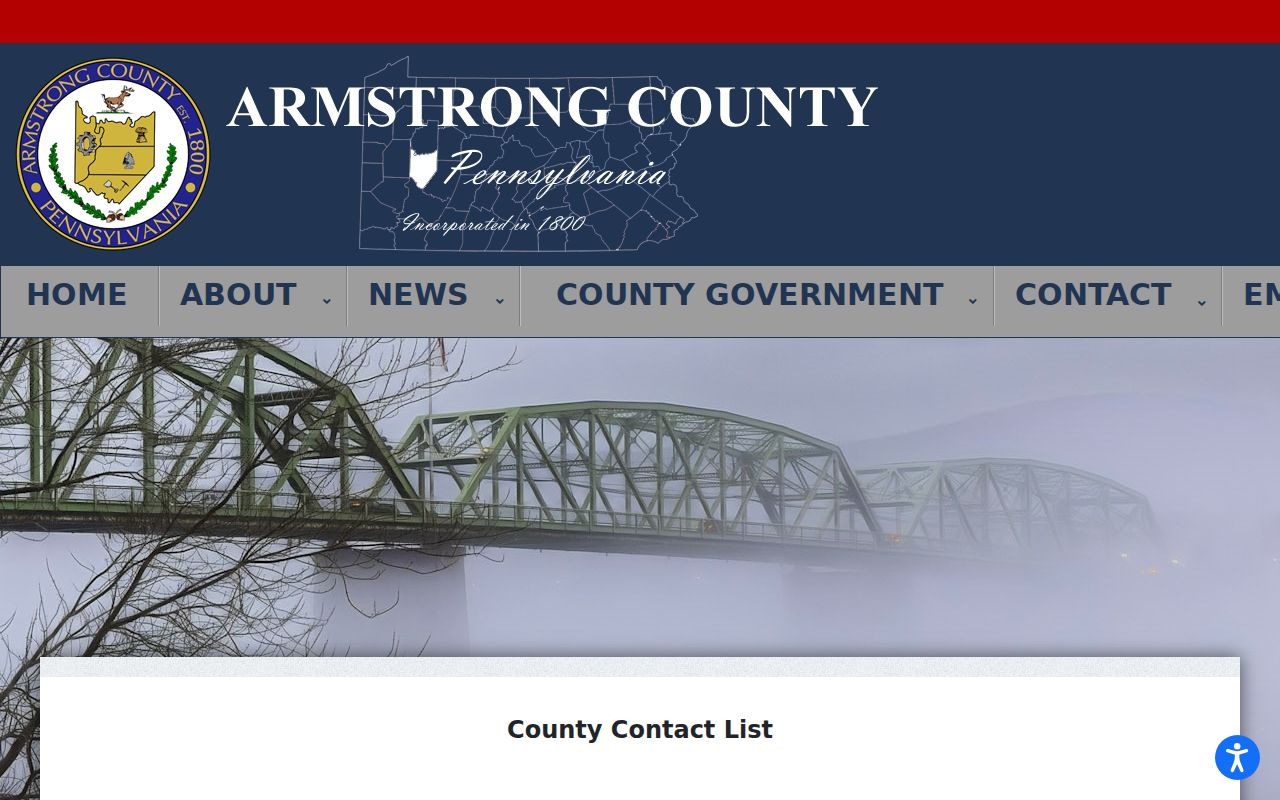
For a Kittanning requester, the practical lesson is to confirm the correct suite and entrance instead of treating the courthouse as one records desk.
The Kittanning Police Department
Kittanning Borough Police Department is at 300 South McKean Street, Kittanning, PA 16201. The nonemergency number is 724-543-1538, while emergencies go to 911. The research found no dedicated online report-copy portal, published report fee, or separate records-counter hours. A caller should describe the event and ask for the Open Records Officer or the current report-request procedure.
Useful details include the incident date, location, involved name, officer or incident number if known, and the exact record sought. A narrow request for an identifiable existing record is more workable than a request asking the department to answer broad questions. Investigative portions, victim information, protected identifiers, juvenile information, and other confidential material can be withheld or redacted.
The borough’s official Kittanning contact page includes required name, email, and message fields plus CAPTCHA. Its captured interface shows the verified local starting point for police-contact questions.
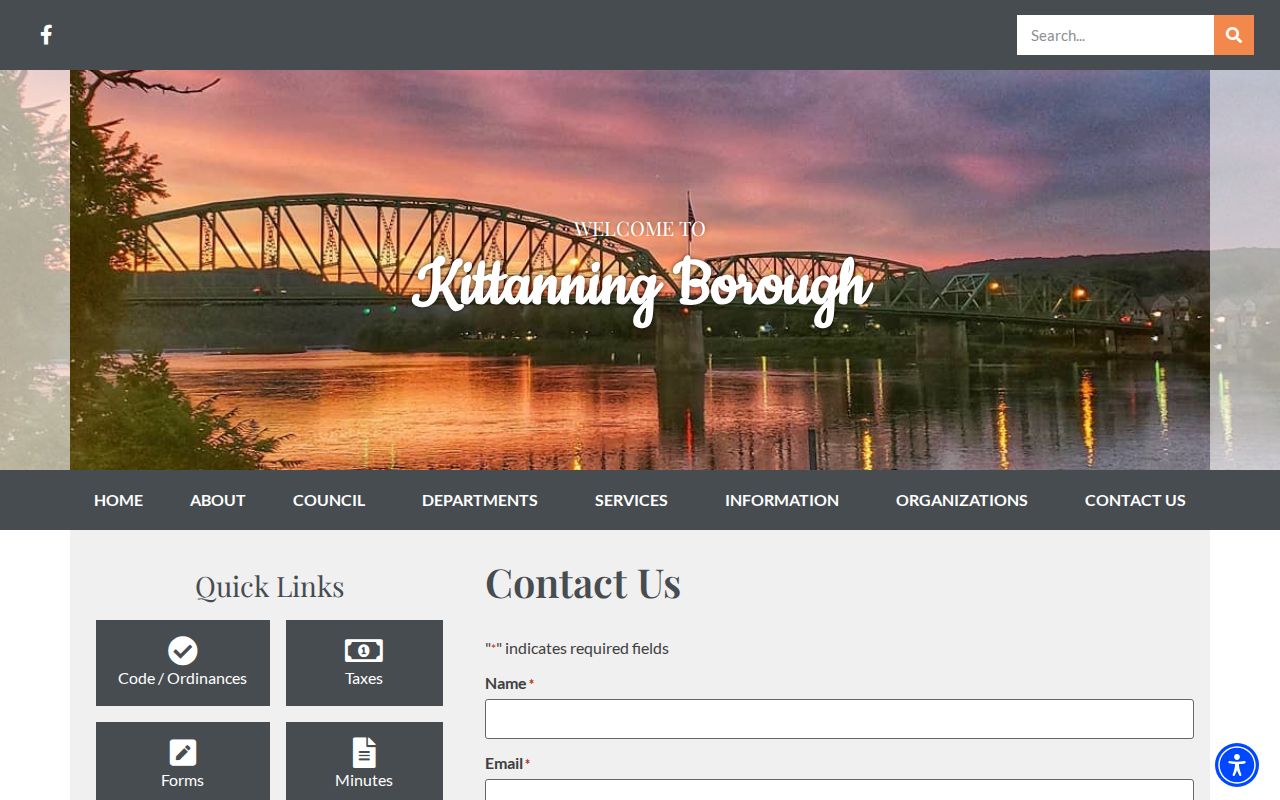
The form is a contact route, not proof that a report will be released or a promise of a particular response time.
Kittanning Has an MDJ, Not a Municipal Court
Pennsylvania calls Kittanning’s local court a Magisterial District Court. MDJ 33-3-02 is at 128 South Grant Avenue and can be reached at 724-543-2313. Calling it a municipal court would misstate the court structure. The MDJ handles criminal complaints, preliminary arraignments, bail, preliminary hearings, and summary matters within its jurisdiction.
Felony and misdemeanor cases that are held for court move to the Court of Common Pleas of Armstrong County. Summary matters can remain at the district level. This split explains why a name search limited to Common Pleas can miss a matter that is still before the MDJ, while a lower-court search will not contain the later Common Pleas docket.
Quick distinction: Kittanning Borough creates local police reports, MDJ 33-3-02 creates lower-court records, and the county Clerk keeps Common Pleas files.
Arrests and Bookings in Kittanning
Kittanning has no documented borough jail. When a person is accepted for county custody, Armstrong County Jail creates the booking file at 171 Staley’s Court Road. That file can concern intake time, identifiers, charges, bail, housing, custody status, a photograph, fingerprints, and release. It does not replace the Kittanning police report or later court disposition.
No official public Armstrong County inmate roster was located. Call jail administration at 724-545-9222 for public custody information. If a phone confirmation is not enough, ask the jail about a focused request for a releasable booking record. State custody is separate: after a state sentence, the appropriate channel is the PA DOC Inmate/Parolee Locator.
An arrest is an allegation, not proof of guilt. A booking charge may later be changed, withdrawn, dismissed, or replaced by the charge the district attorney files. Anyone reading Kittanning arrest material should also locate the court disposition.
A Kittanning Arrest’s Court Path
A borough officer first creates an incident or arrest record. The complaint then reaches MDJ 33-3-02, where preliminary arraignment, bail, and a preliminary hearing or waiver may occur. A qualifying case held for court is filed in Common Pleas, normally under an Armstrong docket formatted CP-03-CR followed by a sequence number and year.
UJS can be searched by participant, docket number, organization, OTN, police incident or complaint number, or SID. The OTN is especially useful because it connects a charging event across systems and can separate people with similar names. A public docket can show charges, grading, bail, counsel, events, disposition, sentence, and financial entries. It does not guarantee that every filed document is downloadable.
For deeper treatment of charges, motions, pleas, and sentences, the countywide Armstrong County court case lookup explains the Common Pleas record. Kittanning police or jail material should still be requested from its own custodian.
Kittanning Magisterial District Court Records
The UJS public view is the fastest starting point for an MDJ 33-3-02 case, but the court office remains the source for a record that is not available remotely. Searchers should first choose Magisterial District Court and Armstrong County, then use the most exact identifier available.
| Court Name | Magisterial District Court 33-3-02 |
|---|---|
| Location | 128 South Grant Avenue, Kittanning |
| Case Types Heard | Criminal complaints, preliminary proceedings, bail, summary matters, traffic, and non-traffic matters within the district |
| Case Lookup Channel | Free UJS docket search or the MDJ office at 724-543-2313 |
| What the Docket Shows | Docket number, participants, charges, events, bail, and disposition entries that are public |
| Copies and Fees | Ask the court for the current quote; no local fee schedule was verified in the research |
A docket sheet is an index and history of the proceeding, not a certified copy of every underlying filing. Restricted, sealed, juvenile, and protected information will not appear like an ordinary public case.
If PSP Investigated Near Kittanning
A Kittanning mailing address does not prove that borough police created the report. Pennsylvania State Police may handle an event outside the borough or within state-police jurisdiction. In that situation, the report request stays with PSP, not Kittanning Borough Police or the Armstrong County Sheriff.
Crash reports also follow the record creator. Pennsylvania provides a PennDOT crash-report request channel for applicable reports, while a police incident record uses the responsible agency’s procedure. Ask which agency number appears on the notice, citation, complaint, or insurance paperwork before sending a request.
This is a common source of delay. The Sheriff’s office can discuss sheriff-held warrant-service or transport material, but cannot supply a PSP or borough report merely because the event occurred in Armstrong County.
Where Kittanning Records End Up
Local records move in stages. Police report arrest fingerprints and charge data to the Pennsylvania State Police Central Repository. Courts later report dispositions. A lag, a changed identifier, or an unreported disposition can leave a temporary or lasting mismatch among a booking record, a UJS docket, and PATCH.
Record flow: Kittanning Borough Police › MDJ 33-3-02 › Armstrong County Court of Common Pleas › Pennsylvania State Police Central Repository
Recent details are most likely to sit with the borough police, jail, or MDJ. Common Pleas supplies the later judicial history. PATCH draws from repository reporting, while Access and Review is the right PSP product for a person checking and correcting their own complete Pennsylvania record.
Kittanning History Shapes Its Records Geography
Kittanning occupies a site tied to Lenape Kit-Han-Ne and the Kittanning Path, then grew into the county seat along the Allegheny River. Court first convened in the county in 1805. The courthouse built around 1852 to 1853 burned in 1858, and the present Greek Revival courthouse followed in 1858 to 1860.
The old sandstone jail, built in the nineteenth century near the courthouse and linked by a covered passage, now serves as records and information-technology space. The present jail opened in 2003 at its separate Staley’s Court Road site. That history helps explain why someone seeking a Kittanning record may encounter a modern office, a historic records building, and a separate custody facility.
The borough’s official Kittanning history provides the local context shown in the captured view below.
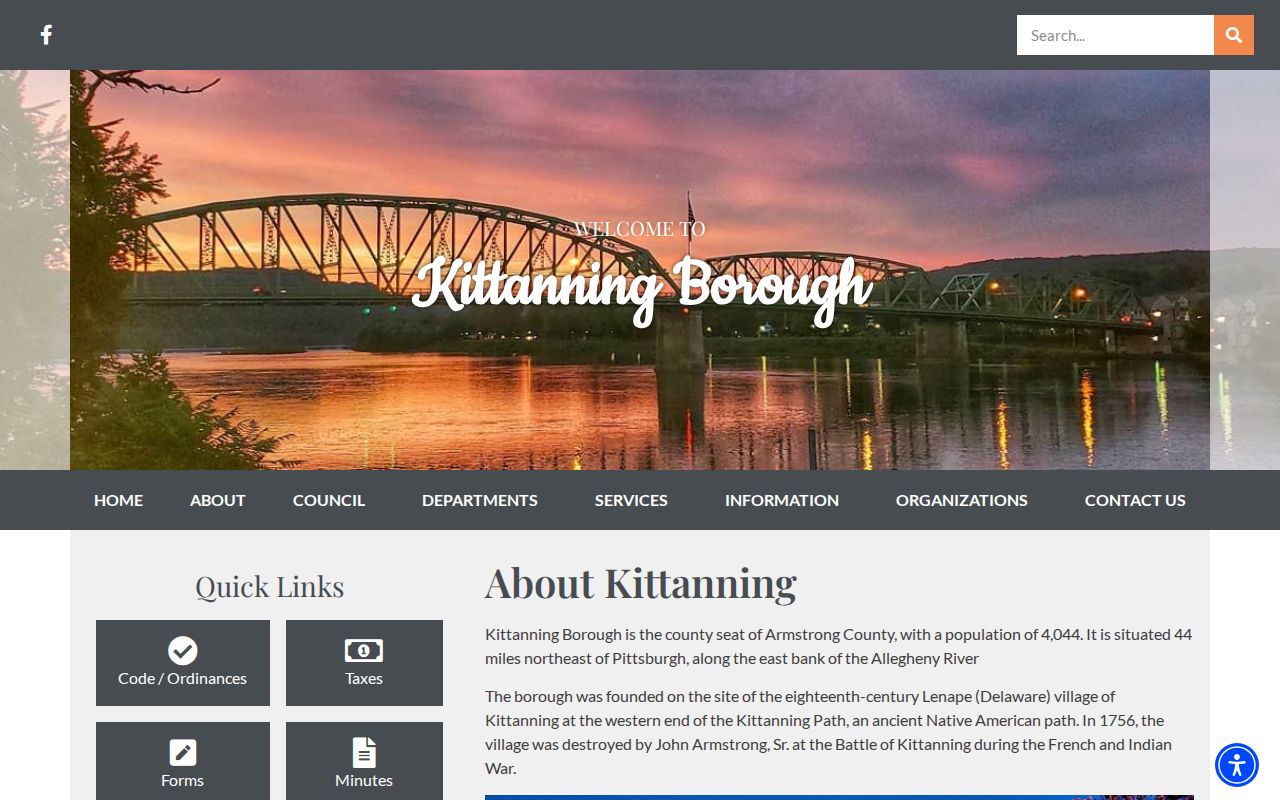
The history is more than scenery: county-seat institutions make Kittanning a records hub without turning them into one combined archive.
Public Access Rules
Public access depends on the custodian and record class. Borough executive-agency records can fall under the Pennsylvania Right-to-Know Law, but judicial files follow UJS policies. Criminal investigative records, victim or informant details, juvenile material, sealed matters, and protected identifiers may be withheld or redacted. Police audio and video requests use Pennsylvania Act 22 rather than the ordinary RTKL path and must be served within 60 days of the recording date.
Key statutes and policies:
Pennsylvania Right-to-Know Law presumes agency records open subject to exemptions and procedure.
18 Pa.C.S. § 9121 governs dissemination of Pennsylvania criminal-history information.
UJS Case Records Public Access Policy governs access through court custodians and protects listed information.
Pennsylvania Act 22 procedure governs requests for law-enforcement audio and video recordings.
A clear request identifies the record, subject, date range, and preferred medium. Public access does not mean that every record is online or that every part of an open file is unredacted.
Reading Kittanning Results Together
Compare records by identifiers and dates, not by name alone. A Kittanning police number identifies an agency event. An OTN connects the arrest and charge cycle. A district docket tracks the MDJ proceeding, and a CP-03-CR number identifies the Common Pleas case. Each answers a different part of the history.
- Complaint
- The document that starts criminal charges and states the alleged offenses.
- Preliminary hearing
- The MDJ proceeding that tests whether a prima facie case should move forward.
- Disposition
- The outcome of a charge, such as guilty, dismissed, withdrawn, acquitted, or nolle prosequi.
- Limited access
- A restriction hiding a qualifying case from ordinary public access without necessarily destroying it.
If a result appears incomplete, check whether the matter is at the MDJ or Common Pleas stage, then ask the record custodian. For an error in a person’s own repository history, use PSP Access and Review rather than relying on a city-level name search.